


The 468 Rule: What Every Hong Kong HR Team Must Check Before Year End
Since 18 January 2026, Hong Kong’s Employment Ordinance has moved from the long standing “418 rule” to the “468 rule” for determining continuous employment.
For many HR teams, the impact has become clear not at rollout, but later — often at audit or review stage — when part time employees unexpectedly qualify for statutory leave based on rolling working hour calculations.
As a result, the key questions have shifted:
- Are we applying the rule correctly in daily operations?
- Have we missed employees who now qualify for statutory benefits?
- Could this create compliance or cost exposure at year end?
This article highlights the areas HR should revisit, common pitfalls observed, and how better workforce data visibility can support more consistent compliance over time.
A Quick Refresher: The 468 Rule at a Glance
Under the 468 rule, introduced by the Employment (Amendment) Ordinance 2025, Hong Kong has revised how a “continuous contract” is determined under the Employment Ordinance.
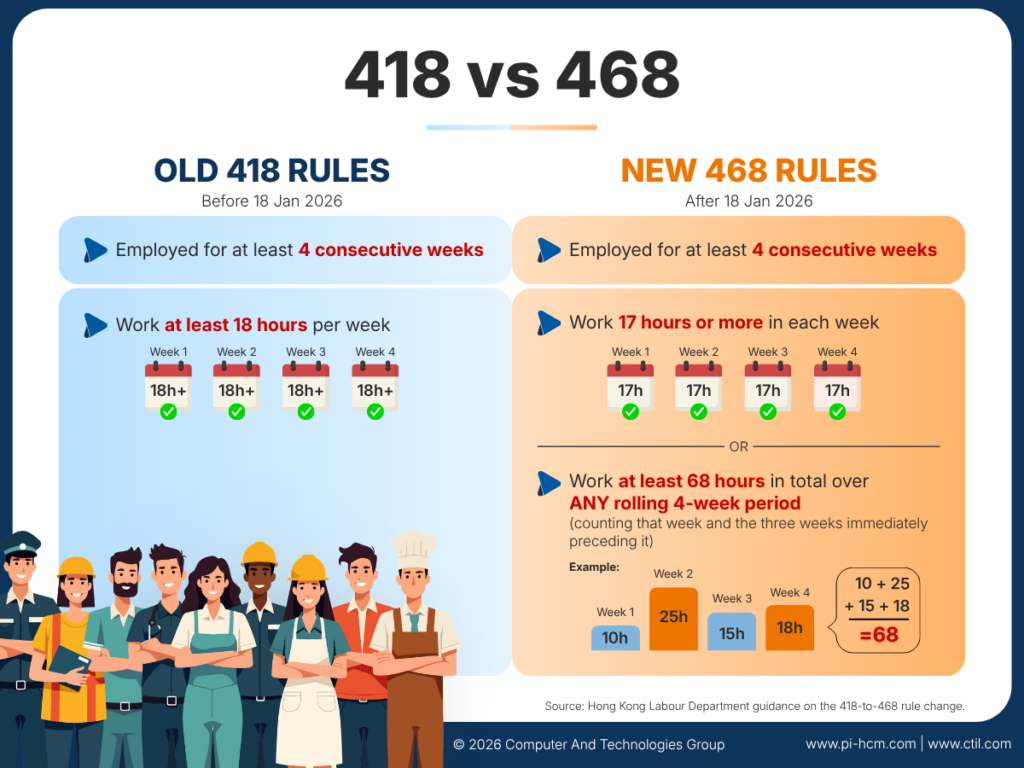
In practical terms, an employee is regarded as being employed under a continuous contract if they:
- Are employed for at least 4 consecutive weeks, and
- Work either:
- 17 hours or more in each week, or
- At least 68 hours in total over any rolling 4 week period (counting that week and the three weeks immediately preceding it)
This replaces the rigid “18 hours every week” requirement under the old 418 rule, where a single short hour week could break continuity even if the employee worked regularly overall.
Why the change?
Labour Department guidance explains that the revised rule better reflects modern working patterns, especially where hours fluctuate across weeks, and reduces artificial disruption of employment continuity caused by scheduling practices.
Why this matters for employers:
More part time and irregular hour employees now meet the legal definition of continuous employment — in many cases without any change to their actual working arrangements.
As a result, a broader group of employees may qualify for statutory benefits, including:
- Paid rest days
- Statutory holidays
- Annual leave
- Sickness allowance
- Maternity / paternity leave
- Severance and long service payments
The Government estimates that around 11,000 additional employees¹ are now covered under the revised rule.
Importantly, where disputes arise, the burden of proof rests with the employer, increasing the importance of accurate hour tracking and defensible employment records.
Why HR Still Gets Caught Out
From our work with Hong Kong enterprises across retail, hospitality, logistics, education, and professional services, several recurring challenges continue to surface.
1️⃣ Rolling 4 Week Tracking Is Harder Than It Looks
The biggest shift isn’t legal — it’s operational.
- HR can no longer rely on fixed weekly cut offs
- Every employee’s hours must be assessed across any 28 day window
- One “light week” no longer breaks continuity if later weeks compensate
Many payroll and attendance systems were originally built around weekly logic, not rolling calculations. As a result, HR teams are often:
- Running manual Excel checks
- Reconciling rosters after payroll is processed
- Identifying eligibility issues only at audit or complaint stage
In larger organisations, these challenges are often magnified by decentralised rostering, multiple payroll systems, or inconsistent data standards across departments, making rolling hour compliance difficult to manage centrally.
⚠️Risk: missed entitlements, back pay exposure, and Labour Department penalties of up to HK$50,000 per breach.
2️⃣ Policies May Be Updated — But Are Systems Aligned?
Most organisations have already updated:
- Employment contracts
- HR manuals
- Leave policy definitions
However, compliance gaps frequently occur between policy and execution.
Common breakdowns include:
- No system alerts when employees approach the 68 hour threshold
- Line managers unaware when continuity is triggered mid period
- Payroll teams applying statutory benefits retrospectively
Without alignment across rostering, attendance, and payroll systems, even well written policies can still result in errors. In addition, the governance layer is another factor to consider — policies may be approved centrally, but system configurations and execution can differ across teams, locations, or brands.
3️⃣ Labour Costs Are Rising — and Need Forecasting, Not Guesswork
For industries with large part time workforces — retail, F&B, logistics, events — the cost impact of the 468 rule is now part of ongoing workforce planning:
- More employees entitled to paid holidays and leave
- Higher MPF contributions
- Additional headcount required to cover increased leave usage
For SMEs in particular, the challenge is not only higher costs, but cost unpredictability. At enterprise level, the impact is often less about individual employee cost and more about portfolio wide exposure across business units, brands, or operational functions.
Leading HR teams are responding by using workforce analytics to:
- Model different rostering and staffing scenarios
- Forecast statutory benefit exposure
- Balance compliance, workforce stability, and business sustainability
4️⃣ Scheduling “Around” the Rule Is Risky — and Increasingly Visible
Some employers have explored capping staff hours at around 16 hours per week on average to avoid triggering continuous employment under the 468 rule. While this may appear technically feasible, it carries growing operational, compliance, and reputational risk.
In practice, this approach often leads to:
- Lower morale and higher turnover, as employees face unstable hours and income
- Operational inefficiencies, with managers juggling more staff to cover shifts
- Visible scheduling patterns, as systematic hour capping is easily identifiable in attendance and payroll data
- Increased scrutiny, particularly if complaints arise or records are reviewed during audits or inspections
As awareness of the 468 rule grows, HR leaders are recognising that short term avoidance tactics can create longer term workforce instability and compliance exposure.
From a recruitment perspective, this has prompted many organisations to move away from repeatedly hiring casual staff to dilute hours, and instead invest in fewer, more stable part time roles that support predictability, continuity, and lower hiring churn.
5️⃣ Edge Cases Create the Highest Compliance Risk
Many compliance issues arise not from misunderstanding the 468 rule itself, but from edge cases that emerge over time and across organisational boundaries.
Common examples include:
- Consecutive low hour weeks, where an employee works below 17 hours for two weeks in a row — breaking continuity even if total hours in a later four week period exceed 68
- New hires, whose employment continuity has a defined start point and must be established by meeting the required weekly or aggregate thresholds, rather than assumed from day one
- Existing employees, who may trigger break points and restart points in continuity when specific working hour patterns occur
- “Retire and rehire” or contract renewal scenarios, where continuity may unintentionally restart if employment is deemed uninterrupted
These situations often occur across teams, business units, or employment phases, making them difficult to detect without consistent, rolling assessment and central visibility.
6️⃣ The 468 Rule Doesn’t Exist in Isolation
The 468 rule is not a standalone compliance issue, but part of a broader labour governance and workforce risk ecosystem.
HR teams are implementing the rule alongside other structural changes, including:
- The upcoming abolition of MPF offsetting
- Increases in statutory holidays
- Greater scrutiny around employee vs contractor classification
Taken together, these changes are highlighting the limits of managing workforce compliance through disconnected HR processes. When rostering, attendance, payroll, and recruitment data are handled separately, risks often emerge in how information flows between teams rather than within any single system.
In response, many enterprise HR leaders are taking a more integrated view of workforce data, recognising that consistent application of working hour and entitlement logic across systems is increasingly important for effective governance.
Frequently Asked Questions: The 468 Rule in Practice
- ❓ Does the 468 rule apply to part time and casual employees?
- 💬 Yes. The rule applies to all employees covered by the Employment Ordinance, including part time, temporary, and casual staff, provided the continuous contract criteria are met.
- ❓ If an employee works less than 17 hours in one week, does continuity break automatically?
- 💬 No. A single week below 17 hours does not automatically break continuity. That week may still count if the employee’s total working hours for that week and the preceding three weeks reach at least 68 hours, and the aggregation test is applicable.
- ❓ Does reaching 68 hours over four weeks always guarantee continuous employment?
- 💬 Not necessarily. Continuous employment must be assessed on a rolling and pattern based basis. Certain scenarios — such as consecutive low hour weeks, the early stage of employment, or breaks in service — may still interrupt continuity even if total hours appear sufficient.
- ❓ Have statutory benefits changed under the 468 rule?
- 💬 No. The change affects how continuous employment is determined. The eligibility requirements for individual statutory benefits remain unchanged.
Your Pre–Year End 468 Rule Checklist
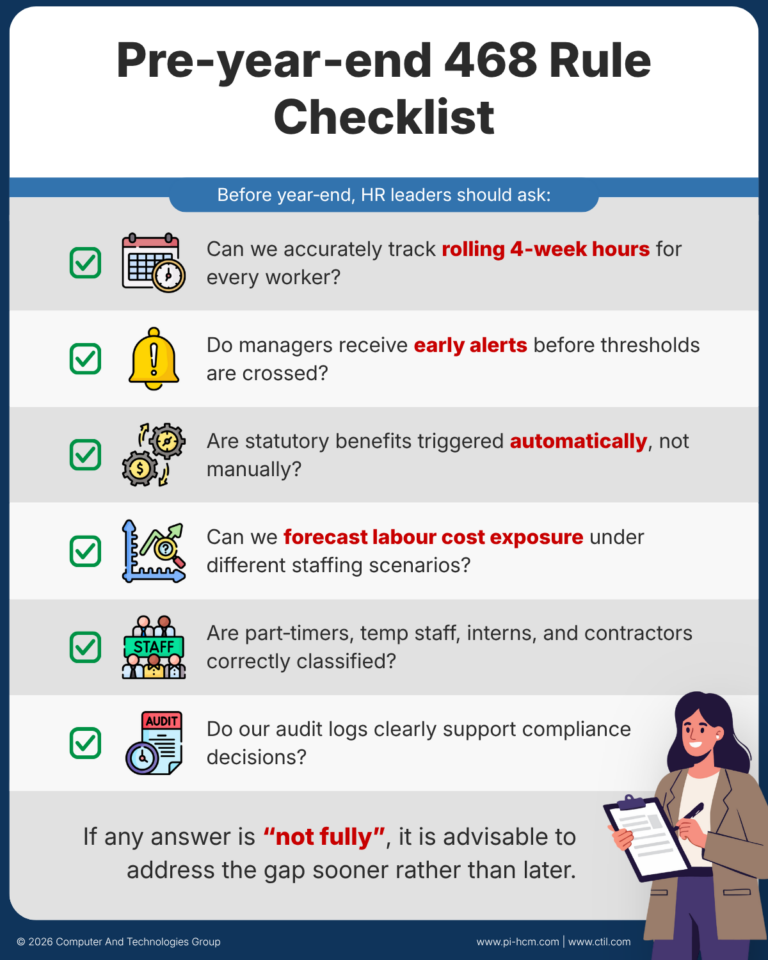
Before year end, HR leaders should ask:
- ✅ Can we accurately track rolling 4 week hours for every worker?
- ✅ Do managers receive early alerts before thresholds are crossed?
- ✅ Are statutory benefits triggered automatically, not manually?
- ✅ Can we forecast labour cost exposure under different staffing scenarios?
- ✅ Are part timers, temp staff, interns, and contractors correctly classified?
- ✅ Do our audit logs clearly support compliance decisions?
If any answer is “not fully”, it is advisable to address the gap sooner rather than later.
Where AI Driven Workforce Management Makes a Difference
As workforce regulations increasingly rely on rolling calculations, patterns, and thresholds, one reality is becoming clear: manual and fragmented HR processes do not scale.
To manage compliance effectively, organisations need more than isolated tools for rostering, attendance, or payroll. They need a unified view of workforce data, where working hours, employment status, entitlements, and cost implications are assessed together — and continuously.
This is where AI driven workforce management plays a practical role. By bringing together scheduling, time & attendance, payroll inputs, and workforce analytics on a single platform, HR teams can:
- Monitor working hours across rolling periods, not just fixed weeks
- Detect eligibility risks and threshold crossings early, rather than retrospectively
- Apply consistent entitlement logic across diverse roles and contracts
- Support workforce planning decisions with real time visibility across demand, capacity and compliance impacts
- Maintain defensible records to support audits, reviews, and internal governance
At C&T, PI HCM is designed around this integrated approach — combining human capital management with intelligent workforce optimisation. Instead of treating compliance, operations, and planning as separate concerns, PI HCM enables HR teams to manage them as connected parts of a single workforce ecosystem.

Learn more about the full solution here: https://www.pi-hcm.com/
Reference:
¹RTHK. Firms ‘won’t feel pay bite of new 468 work-hours rule’. (2026)
This article is provided for general information purposes only and does not constitute legal advice. Organisations should seek independent professional advice when interpreting or applying the Employment Ordinance to their specific circumstances
