


Hong Kong Lags Behind Mainland China and West in HR Digitalization – Unified HCM Platforms Enhance Efficiency and Reduce Costs
Traditional HR tasks in local companies consume significant manpower and resources, and incidents of employee personal data leaks are not uncommon. Companies assisting businesses in digital transformation for human resource management point out that Hong Kong lags behind Europe, the U.S., and mainland China in HR digitization. However, if companies successfully undergo HR digital transformation, it can not only reduce long-term operational costs such as paper and administrative work but also allow for tailored, phased implementation of a one-stop digital system to ensure a smooth transition for frontline employees. The company recommends that businesses fully consider both upfront and long-term costs when selecting digital services.

Leo Siu, General Manager of the HRM Business at the Computer And Technologies Group (C&T Group), stated that some employers and HR managers in Hong Kong resist digitization due to concerns about the impact on frontline employees and the difficulty in justifying upfront investments. Currently, many Hong Kong companies still use the on-premises model, storing data on internal servers due to fears of data breaches when uploading to the cloud. However, Leo emphasized that these concerns can be alleviated by choosing a customized, one-stop digital service. With over 30 years of experience in HR management solutions, C&T Group’s PI HCM system has been awarded the “Best HR Solution Award” by JobsDB Award. Based on client success stories, Leo highlighted the following benefits of HR digitization for local businesses:
1)Cost Reduction and Paperless Transition – Avoiding Large Upfront Investments
Traditional HR tasks involve extensive paperwork, clocking in/out, and other cumbersome processes. The most obvious advantage of digitization is reducing manual operations, which in the long run cuts administrative workloads and lowers operational costs. Opting for a cloud-based SaaS HR system eliminates the need for hefty upfront investments, such as purchasing expensive hardware or licenses, as companies only need to pay an annual subscription fee, easing initial financial burdens. The essence of digitization includes reducing paper usage and moving toward a paperless environment, which is particularly important for companies advocating ESG principles and helps them achieve sustainability goals.
2)Mobile Clock-In/Out and Leave Requests – User-Friendly Interfaces
Previously, employees had to manually clock in/out, while leave requests required calling supervisors or filling out forms. With digitized HR processes, employees can simply log in via a phone app and complete tasks like requesting leave or clocking in/out with a few taps, ensuring ease of use even for frontline staff or those less familiar with smartphones. Recently, C&T successfully implemented the PI HCM system for a catering company with nearly 2,000 employees. Previously, employees had to clock in using cash registers, which disrupted their work. After adopting the new system, they switched to QR code scanning or Wi-Fi/GPS-based clock-in systems, allowing them to complete attendance processes with just their phones. Part-time employees can also check their working hours and days in real time, eliminating the need to wait until the end of the month to confirm their actual hours and earnings.

Leo Siu, General Manager of the HRM Business at the Computer And Technologies Group (C&T Group), stated that by successfully implementing HR digital transformation, enterprises can reduce long-term operational costs such as paper usage and administrative work.
3) Compliance with Legal Requirements & Ensuring Data Privacy Security
Hong Kong’s labor-related regulations are frequently updated. Leo pointed out that the localized payroll engine in their digital system automatically adjusts to align with new labor laws, ensuring seamless compliance with the latest legal requirements. For example, in the case of MPF offsetting, C&T’s PI HCM System automatically calculates the employer’s contribution and integrates with the MPF platform to streamline the payment process.
Regarding privacy protection, the system uses data masking technology to encrypt personal information in the cloud, preventing external parties from identifying specific details and significantly reducing the risk of data breaches. C&T has obtained ISO 27001 certification in Hong Kong, ISO 27701 and ISO 27001 certifications in mainland China, as well as the “Level 3” certification under China’s Multi-Level Protection Scheme (MLPS). Leo emphasized that these certifications are fundamental for entering both the Hong Kong and global markets, enhancing client trust. Additionally, PI HCM’s payroll system supports compensation calculations across Greater China, accommodating diverse payroll structures while enabling overseas business expansion.
4) Tailored One-Stop Service & Phased Transition for Smooth Implementation
Many Hong Kong companies rely on multiple vendors to handle different HR functions—such as payroll, human capital management, and recruitment—leading to data synchronization issues. To address this, C&T, a specialist in payroll and HR management, recently partnered with Moka HR (a recruitment process optimization platform) and MixCare Health (a healthtech and insurtech provider) to integrate their services into the PI HCM platform. The integration with MixCare Health enhances HR-employee interaction, improving efficiency in managing employee needs across various domains. Meanwhile, the collaboration with Moka HR goes beyond technology—it strengthens the connection between businesses and their most valuable asset: people. By sharing resources and driving innovation, this ecosystem delivers more personalized and efficient services. Leo noted that the system can be customized to cover the entire HR lifecycle, from recruitment, compensation & benefits, onboarding, attendance tracking, and MPF management to offboarding or retirement.
To address employer concerns about disrupting frontline operations during system transitions, Leo emphasized that their one-stop service includes a phased implementation approach, allowing HR and employees to adapt gradually for a smooth migration.
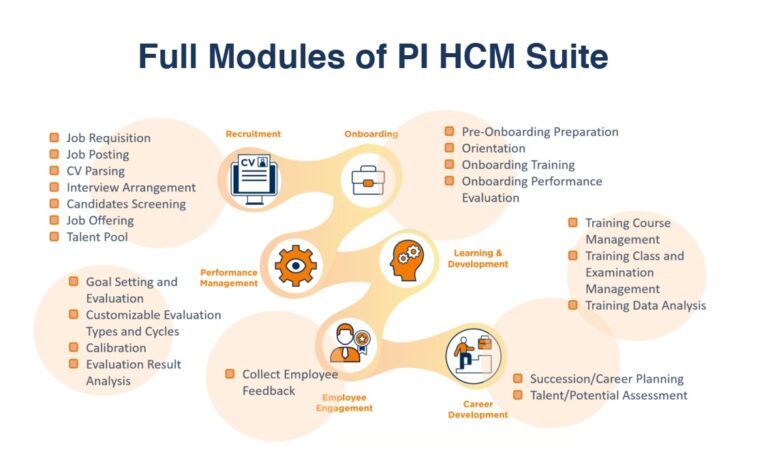
The PI HCM System delivers comprehensive HR solutions to organizational requirements, seamlessly managing the entire employee lifecycle from recruitment and compensation through onboarding, attendance tracking, MPF administration, and ultimately offboarding or retirement processes.
5)AI-Powered Efficiency: Chatbot Support & Smart Scheduling
Traditionally, employee HR queries are addressed through manuals and policy documents. The PI HCM System streamlines this process with an AI chatbot that provides instant responses to inquiries about company policies and guidelines, significantly reducing the HR team’s workload. This allows HR professionals to focus on strategic tasks like employee engagement and data analysis. Additionally, the system’s AI-driven scheduling tool optimizes shift planning by analyzing frontline employees’ past performance and attendance records, automatically generating efficient shift proposals that save time and reduce administrative burdens.
Strategic Recommendations for HR Digitalization: A Cost-Conscious Approach
When transitioning to digital HR systems, businesses should prioritize three key factors: First, partner with reputable providers to ensure system reliability. Second, implement robust data security measures for employee information. Third, evaluate both immediate and long-term costs, with SaaS platforms offering flexibility and easy upgrades. Large companies relying on Excel will struggle to meet modern HR needs, while SMEs benefit most from SaaS solutions that reduce admin work. This digital shift boosts employee satisfaction, improves retention, and maintains competitive advantage.

PI HCM | Reinvent Your Employee Experience
Learn more about PI HCM: www.pi-hcm.com
Request demo now: www.pi-hcm.com/contact-us
Sources page: www.ctil.com/english/content/hong-kong-lags-behind-mainland-china-and-west-hr-digitalization-unified-hcm-platforms
